Forms will ask better questions.
They will adapt to service type, urgency, location, and customer intent instead of sending every request into the same inbox.
AI will reach the website, the call, the form, the text, the email, the schedule, the quote, the follow-up, and the CRM. But the best companies will not make the customer feel like they are talking to a machine.
◆ The memo
The important question is not whether contractors will use AI. They already will, directly or indirectly. The question is where the automation sits.
Home service companies are full of small handoffs. A customer fills out a form. Someone checks the inbox. A dispatcher asks two clarifying questions. A technician gets a note. A quote needs a follow-up. A CRM record needs to be updated. A missed call needs a second touch.
Most of the AI conversation treats those moments like a chance to replace people. That is the least interesting version of the future.
The better version is quieter. AI reads the request, sorts the details, catches the urgency, writes the record, alerts the team, drafts the follow-up, and keeps the CRM clean. The customer may never know it happened. They only know the company responded clearly and quickly.
The future is not a customer arguing with a bot. It is a contractor who sees the right job, with the right context, before the window closes.
That distinction matters because home services are still trust businesses. People invite technicians into their homes. They make expensive decisions under stress. A homeowner with no heat or a failed water heater is not buying a software experience. They are looking for competence, speed, and proof that somebody real is paying attention.
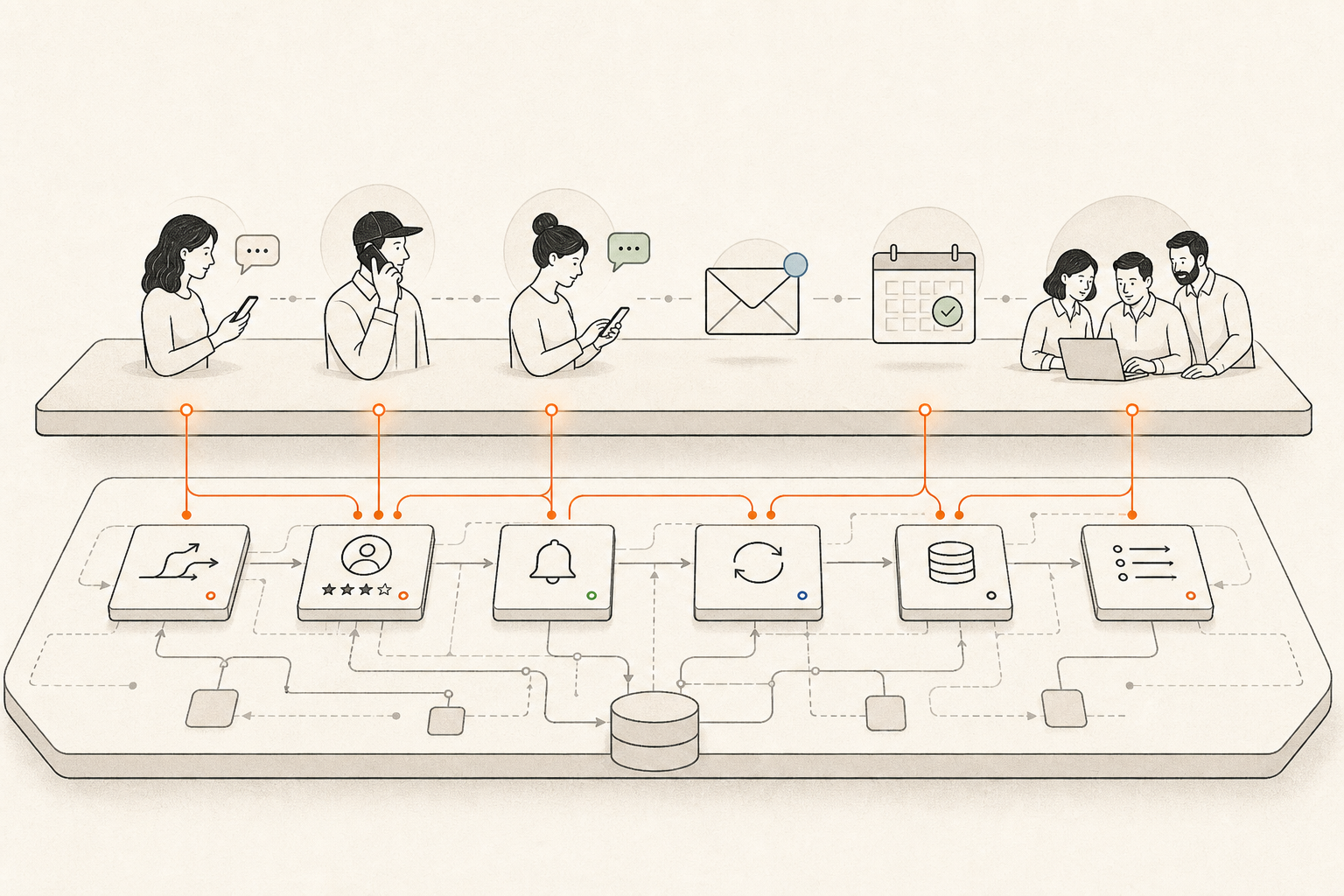
◆ Everywhere AI enters
AI will not arrive as one product. It will appear as small improvements across the entire intake and operations path.
They will adapt to service type, urgency, location, and customer intent instead of sending every request into the same inbox.
Missed calls, after-hours texts, and quote requests will be summarized so the next action is obvious.
Availability, service area, job type, and callback windows will be connected earlier in the conversation.
Second touches, quote reminders, and unhandled requests will be triggered from the record instead of left to chance.
The team will know the service need, constraints, notes, and likely value before rebuilding the story from scratch.
Records, notes, status changes, and routing data will be written automatically from the intake trail.
◆ The false choice
Contractors are often told to choose between staying manual or letting software talk to the customer. That misses the middle path where most of the value lives.
◆ What changes
The practical future of AI in home services is not theatrical. It is operational.
The first response no longer depends on whether someone happened to check email, hear the phone, or remember a note from earlier in the day.
The person calling back knows what the customer needs, how urgent it is, where they are, and what should happen next.
Owners can see which leads were handled, which stalled, and which need another touch before they disappear.
The record gets created from the intake event, not from a person retyping details after the business has already moved on.
Automation does the sorting, routing, writing, and reminding. The team keeps the trust-bearing moments.
◆ Service Lab position
For trades businesses, the job is not to look advanced. The job is to catch the lead, understand the request, and help the customer faster.
Do not make people negotiate with automation when they are trying to solve a home problem.
Classify, store, and route the lead before third-party tools or busy humans can lose the thread.
Automation should give the team a cleaner record, faster alert, and clearer next move.
◆ The real advantage
They will answer faster. They will miss fewer leads. Their dispatchers will have cleaner context. Their owners will know what happened to every opportunity. Their customers will feel like the business is organized.
That is the useful future. Less theater. Better handoffs. More trust.
AI belongs inside the system, not between the homeowner and the confidence they are looking for.
◆ Next step
We build the layer that captures, stores, routes, and follows up on leads before they fall through the cracks.